Last updated: October 2026
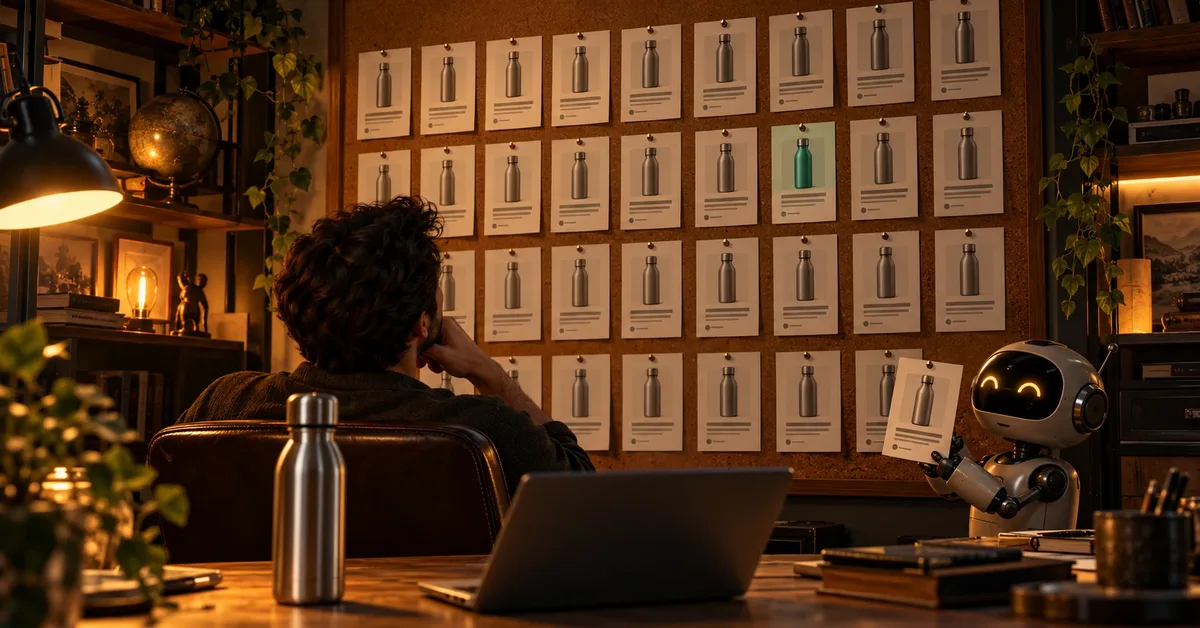
If you ask ChatGPT for ten product descriptions in a row, they start to sound the same. The same words, the same openings, the same feel. I noticed it first with images: when I make many pictures in the same conversation, they come out almost identical, and I wrote about how I deal with that in my guide to making product images with ChatGPT.
My theory was that ChatGPT “remembers” what it did earlier in the same chat and keeps repeating it. But is that really what is happening? And does it also happen with text? I asked Claude, the AI assistant that helps me with this website, to run a test and measure it.
The Short Version
- ChatGPT repeats itself even in brand new chats. Starting a new conversation did not make the descriptions more different.
- What did make a big difference was asking it, in the same chat, not to reuse earlier openings, phrases or structure.
- When I gave it no features, it invented them. Leak-proof lids, rust-resistant steel and double-wall insulation all appeared without being asked.
How the Test Was Done
We used the free web version of ChatGPT without logging in, on October 25, 2026. We always asked for the same thing: “Write a product description for a stainless steel water bottle aimed at hikers. 60 words maximum.”
| Group | What we did | Descriptions |
|---|---|---|
| New chats | The same prompt, each time in a brand new chat | 5 |
| Same chat | The same prompt sent six times in one conversation (we compare messages 2 to 6, since the first one is just a new chat) | 5 |
| Same chat, new instruction | Three more messages asking for “another description” and telling it not to reuse any opening, phrase or structure from its previous answers | 3 |
Then a short script measured how much each group had in common. It counted the share of words that two descriptions have in common, and the share of three-word phrases they have in common. Zero percent means nothing in common, and 100 percent means identical.
The Results
| Group | Words in common | Three-word phrases in common |
|---|---|---|
| 5 new chats | 37% | 8.5% |
| Same chat (messages 2 to 6) | 40% | 7.0% |
| Same chat, after “do not reuse” | 17% | 1.0% |
The first two lines are almost the same. In other words, in this test, the descriptions from a long conversation were not more repetitive than the ones from brand new chats. The big drop came only with the last line, the explicit instruction.
What We Noticed
1. New chats repeat too
Four of the five new chats started with “Stay hydrated on…”. Words like “rugged”, “trail” and “durable” appeared in almost every description, in new chats and in the long chat alike. The title of each of the first six descriptions in the long chat also used a word like adventure, trail, hiking or hydration.
2. Asking for something different works
When we added “do not reuse any opening, phrase or structure from your previous answers”, the writing changed. Openings became things like “From steep switchbacks…” and “When the terrain gets tough…”. Words such as “rugged” and “trail” mostly disappeared.
3. It dropped the word, but kept the idea
The words “leak-proof” and “leak” went from almost every description to none. But the idea came back in other words: “secure cap helps prevent unwanted spills”, “spill-resistant convenience” and “tight-sealing lid helps contain splashes”. The AI avoided the phrase, not the claim.
4. It invented features
I did not give ChatGPT any features of the bottle. Even so, it described a leak-proof lid in most of the first descriptions, rust-resistant steel in two of the five new chats and double-wall insulation in two more. After the new instruction, it added things like “less single-use plastic” and “unpredictable weather”. None of that came from me.
If you sell real products, this matters. An invented feature in a description can mislead a customer.
5. It respected the word limit
All 14 descriptions stayed under 60 words, with the bodies between 50 and 58 words.
What This Means for Your Prompts
- Do not rely on a new chat to get variety. In this test, it did not help by itself.
- Ask for variety directly. Tell the AI not to reuse openings, phrases or structure, and, even better, name the angle: price, durability, eco-friendly, gift idea.
- Always list the real features. If you do not, the AI will invent them.
- Check the result against your product. Remove anything you cannot promise.
- Ask for several options in one go, and choose or mix the best parts yourself.
For more examples of how to write clear instructions, see our guide to the best ChatGPT prompts, or read what I learned in the mistakes I made when I started using AI.
What About Images?
This test was only about text. My original observation was about images, and I have not measured that. What I do in practice is tell ChatGPT not to carry over what it did earlier in the conversation, and I ask for a different background each time. The text test suggests the second part, asking for something different, is the useful one.
Frequently Asked Questions
Does ChatGPT remember what it wrote earlier in the same chat?
It can see the earlier messages in the conversation, but in this test, that did not make its descriptions more repetitive than in new chats.
How do I get ChatGPT to stop repeating itself?
Tell it directly not to reuse openings, phrases or structure, and say what angle you want. That was the only thing that clearly worked in our test.
Does it make up product features?
Yes, when you do not give any. In our test, it invented several. Always list the real features.
Does the same happen with images?
I have noticed it with images, but I have not measured it. This test only looked at text.
Is this true for every version of ChatGPT?
We only tested the free web version, with one prompt, on one day. Other versions and prompts may behave differently.
My Take
I started this test thinking that a long conversation made ChatGPT repeat itself. I was only half right. The repetition is just how it writes by default for this kind of prompt, and the fix is to ask for something different on purpose. The other lesson, which surprised me more, is how easily it invents features when you do not give it any.
Keep Reading
- How I Make Product Images With ChatGPT (and Fix the Mistakes)
- Best ChatGPT Prompts in 2026
- How I Choose Which AI to Use for Each Task
About This Test
This article is independent. I have no sponsorship from OpenAI or any other company mentioned, and I do not earn commissions from the tools covered. The test was run by Claude, the AI assistant that helps me with this website, following my instructions, on October 25, 2026. It used the free web version of ChatGPT, one prompt and 14 descriptions, so results may be different with other prompts, versions and dates.
Disclaimer: AI products and features change quickly. Always check product descriptions against the real product before you publish them.